BLOG
CRI (Color Rendering Index) is a measurement that expresses how closely and accurately a light source displays the colors of objects as they appear in natural daylight.
• Scale: 0 – 100
• CRI 100: Closest to daylight, perfect color perception
• Low CRI: Faded, artificial, and unrealistic colors
As the CRI value increases, colors are perceived as more vibrant, natural, and realistic.
Have you ever bought a shirt and tie in a store that looked perfectly matched, only to realize the colors didn't match at all when you left? Or have you ever seen socks that you thought were a pair but were actually different shades in daylight? This isn't related to your eyes. The problem is that the lighting used in your environment has a low CRI (Color Rendering Index) value. In this article, we will discuss the concept of CRI, one of the most critical criteria for choosing the right lighting, in a clear and understandable way without getting bogged down in technical details.
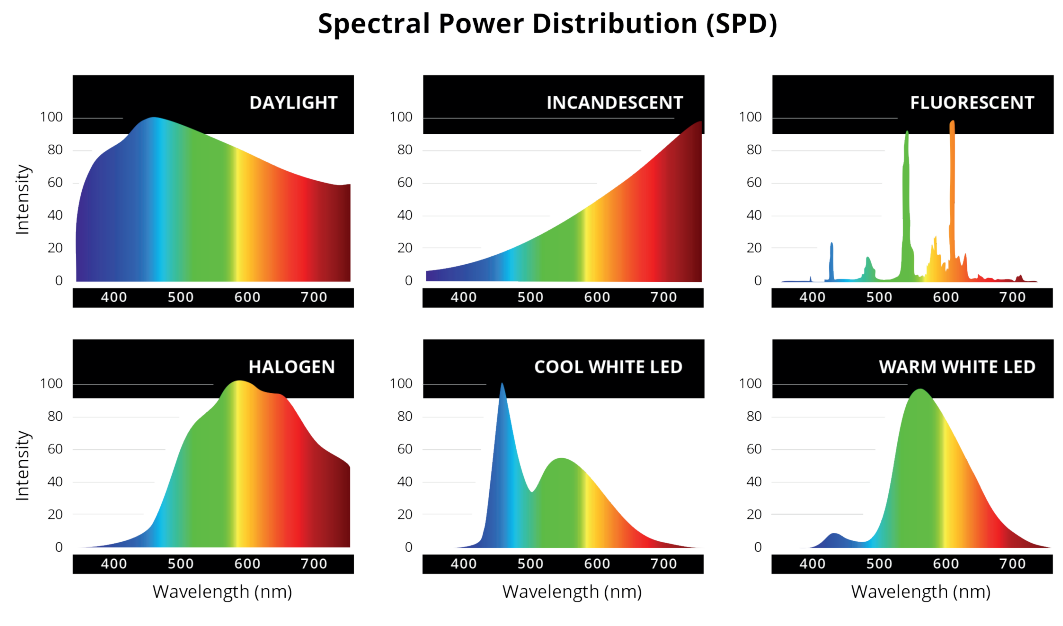
Sunlight contains all the colors in the visible spectrum and their intermediate shades completely. Some of the light hitting an object is absorbed, and some is reflected. Our eyes perceive the reflected wavelengths as color. Therefore, daylight is considered the reference. However, low-quality fluorescent and LED lights emit some parts of the spectrum incompletely. This causes colors to appear different from reality. For example, if the red wavelength is insufficient in the light source, a red product will be perceived as faded or brownish instead of vibrant.
According to international standards (EN 12464), the recommended minimum CRI values are as follows:

The most commonly used method for measuring CRI is the Ra value.
In this measurement:
The smaller the color difference, the higher the CRI value.
Although the Ra value is widely used, it has an important drawback. The calculation only covers pastel tones. Vibrant and saturated colors, especially red (R9), are not included in this calculation.
As a practical consequence:
Therefore, quality lighting manufacturers focus not only on the overall CRI value but also on saturated color performance such as R9.
Result: Right Lighting, Right Perception
When choosing lighting, it is not enough to look only at brightness (lumens) or light color (Kelvin/CCT) values. If you want colors to appear natural, vibrant, and true to life, you should ensure that the CRI value of the product you choose is at least 90.
Remember: Light quality directly affects perception; and perception directly affects experience and quality of life.
OUR LATEST POSTS
© 2026 Pamir | All Rights Reserved.

 TR
TR
 DE
DE
 FR
FR
 AR
AR